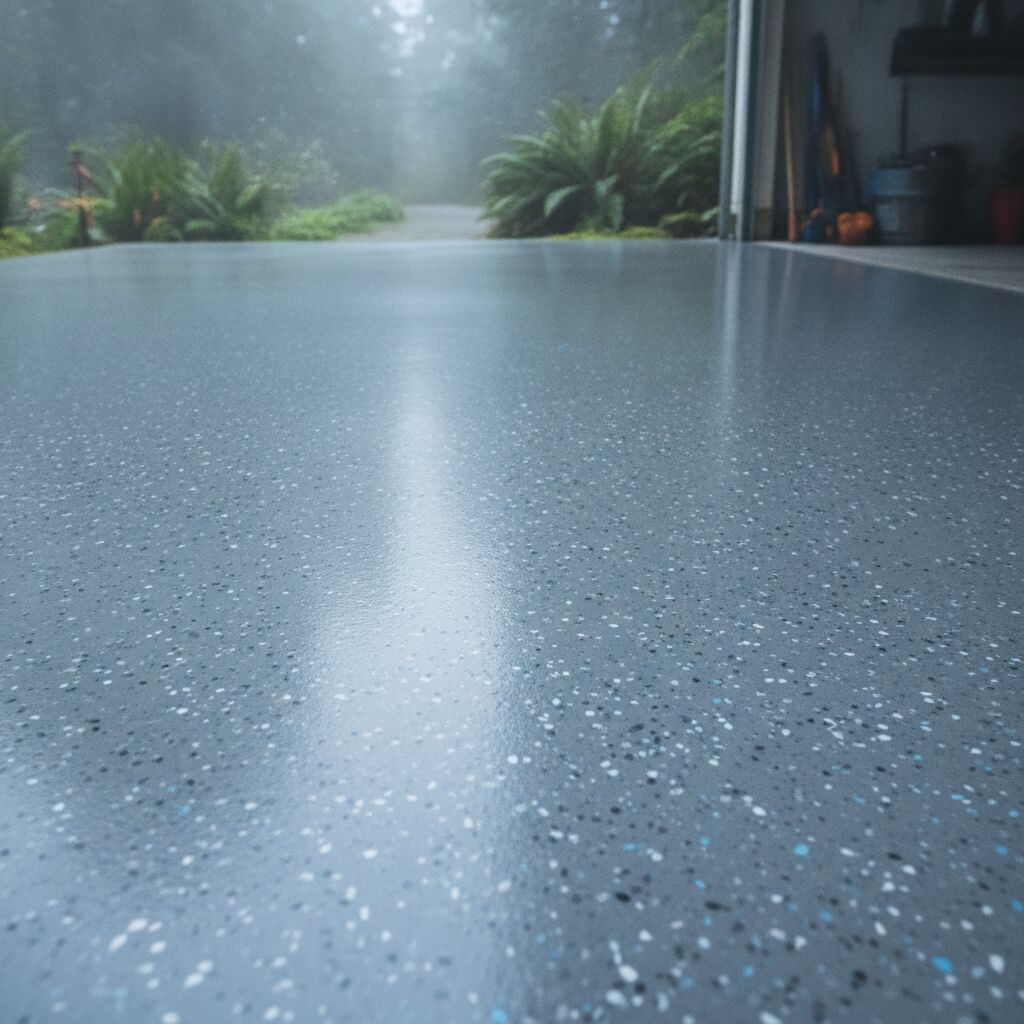
Oregon's rainy season isn't just an inconvenience — it has a real, measurable effect on unprotected concrete. Here's what's actually happening, and why the right coating addresses it rather than just covering it up.
Concrete absorbs moisture from the ground below and, in wet climates, from persistent surface exposure. In a dry climate, a slab gets long stretches to release that moisture back out. In Oregon, with rainfall concentrated heavily across the fall and winter months, that drying window is much shorter.
Persistent moisture in concrete can lead to surface staining, efflorescence (a white mineral deposit left as moisture evaporates), and — in a garage or basement with limited airflow — conditions that support mold and mildew growth.
A coating applied to a slab that hasn't been properly tested and prepped for its actual moisture content is more likely to fail — bubbling, peeling, or delaminating — in Oregon's climate than in a drier one, simply because there's more ongoing moisture pressure from below and around the slab.
A coating system specified for Oregon's conditions — proper moisture testing beforehand, a moisture-tolerant material like polyurea, and a vapor-barrier primer where testing indicates it's needed — is what actually interrupts this cycle rather than delaying the same failure.
Have a garage or basement floor already showing moisture damage? Oregon Polyurea can assess what's actually going on and recommend the right fix — reach out for a free estimate.
No obligation. We'll assess your space and give you a real number.